Reflexive Movement Enhancement Training
The Impact of Cerebellar Damage on Postural Control and Fall Risk
Cerebellar damage impairs the body’s automatic response capabilities and subconscious postural control. As the disease progresses, maintaining this postural stability becomes increasingly difficult, chronically exposing patients to a high risk of falls.
When falls occur, they frequently lead to physical injuries, which cause a precipitous decline in physical activity and mobility. Ultimately, this cycle negatively impacts the patient’s ability to maintain independent living and severely diminishes their overall quality of life.
Falls in patients with cerebellar disorders predominantly occur due to an overlap of internal factors (intrinsic neurological and kinematic deficits) and external factors (environmental and situational demands). When physical balance is disrupted by a combination of these factors, falls result from the patient’s inability to execute adequate postural recovery.
To empower patients with cerebellar disorders to independently prevent falls and recover balance following a perturbation, specialized and highly effective rehabilitation strategies are imperative. A critical component in this process is reflexive movement enhancement training that utilizes brainstem function.
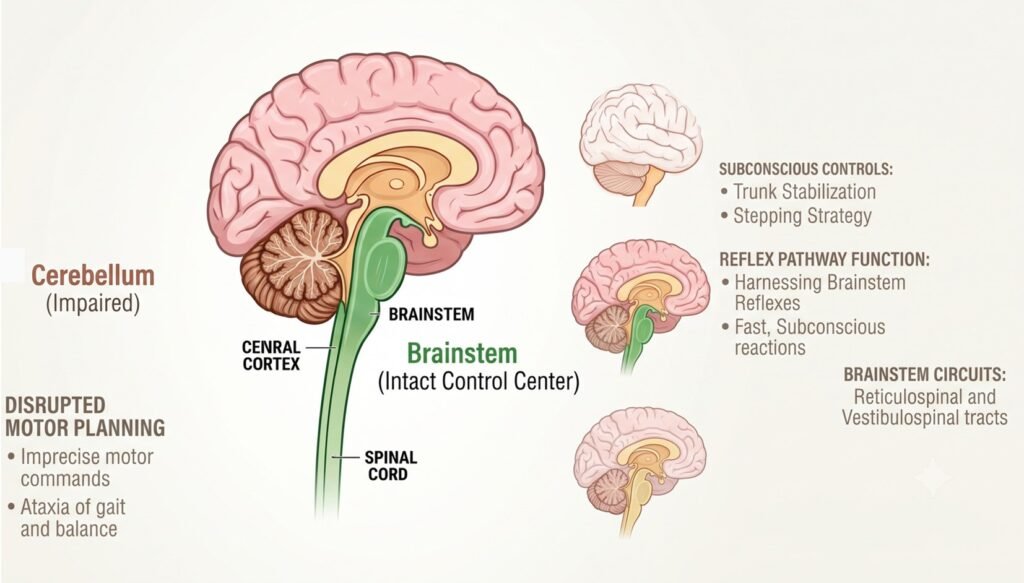
The Role of the Brainstem in Automatic Motor Control
The brainstem is the central hub responsible for the body’s “automatic, subconscious movements.” Specifically, the brainstem is deeply involved in regulating essential physiological functions, including:
• Postural reflexes
• Balance reflexes
• Vestibular reflexes
• Muscle tone regulation
For instance, when the body suddenly loses its center of mass, sways due to changing surface conditions, or slips and nearly falls, our immediate, subconscious physical reactions are primarily driven by this reflexive motor control system centered within the brainstem.
What is Reflexive Movement Enhancement Training?
Reflexive movement enhancement training is an intervention designed to train the body to react automatically before conscious, cognitive movement initiation occurs.
The core objectives of this training are threefold:
1) Recovery of automatic postural control
2) Enhancement of immediate, reflexive responses to sudden balance perturbations
3) Improvement of fall prevention capabilities during gait
Rather than relying on compromised cerebellar motor pathways, this training focuses on activating and strengthening the brainstem–vestibular–spinal reflex circuitry. Because fall prevention heavily depends on these rapid, reflexive postural control mechanisms, active utilization of preserved brainstem function is an indispensable component of cerebellar rehabilitation.
Summary: Maximizing Rehabilitation Efficacy
• Restoring Automatic Responses: Reflexive movement enhancement training is fundamentally designed to restore brainstem-based, automatic postural and balance responses.
• Crucial for Real-World Safety: This specific rehabilitation protocol plays a pivotal
role in preventing falls and ensuring patient safety in everyday living environments.
• Synergistic Efficacy: Ultimately, when this reflexive movement enhancement training is integrated concurrently with the previously discussed explicit motor rehabilitation approach, the therapeutic efficacy for patients with cerebellar disorders is maximized.
Fall Prevention: The Critical Role of Compensatory Stepping
For individuals with cerebellar dysfunction to independently prevent falls and restore balance following a postural perturbation, effective and rapid motor execution is essential. Specifically, a swift and mechanically appropriate stepping response plays a pivotal role. These compensatory stepping reactions are highly effective in averting impending falls, mitigating the risk of fractures and severe injuries, and stably controlling abrupt shifts in body kinematics.
Individually Tailored Fall-Response Training
We provide highly individualized training protocols systematically tailored to each patient’s unique functional capacity and their specific fall characteristics. Our comprehensive approach addresses both the trajectory and the underlying mechanisms of the fall, including:
• Multidirectional Instability: Preparing for posterior (backward), anterior (forward), and lateral (sideways) fall trajectories.
• Specific Fall Etiologies: Addressing distinct causes such as tripping over obstacles, foot dragging, sudden loss of postural tone (collapsing), and orthostatic instability (dizziness upon standing).
Targeted Rehabilitation Methodologies
To augment the patient’s capacity to both prevent and safely manage imminent fall scenarios, our rehabilitation program utilizes evidence-based perturbation paradigms. By employing techniques such as the lean-and-release method and targeted obstacle negotiation training, we systematically enhance the biomechanical efficacy of the initial compensatory step while simultaneously improving trunk motor control. This integrated approach significantly improves the patient’s overall fall resilience and postural recovery capabilities.