Explicit Motor Rehabilitation Training
A Cortex-Based Gait Strategy for Cerebellar Dysfunction
In neurological disorders such as cerebellar ataxia, effective rehabilitation requires a comprehensive approach that actively engages higher brain functions—specifically, the cerebral cortex.
1. What is Explicit Motor Training?
The cerebellum plays a crucial role in the automatic regulation and fine-tuning of our movements. It allows us to walk, maintain posture, and keep our balance without consciously thinking about each individual action. When cerebellar function is impaired, as seen in individuals with cerebellar ataxia, this automatic control system is disrupted. As a result, walking becomes unstable, and maintaining overall posture and balance becomes significantly more difficult.
Therefore, one of the most important priorities in ataxia rehabilitation is to actively engage the cerebral cortex to compensate for cerebellar deficits. This explicit rehabilitation approach leverages cerebral function in two key ways:
1) Conscious Recognition: We guide patients to consciously recognize the fundamental components of gait that are usually automatic—such as controlled weight transfer between the legs, proper postural alignment, and stability during single-limb support.
2) Deliberate Practice: By engaging in attention-focused, deliberate practice of these specific elements, patients can progressively rebuild walking stability and balance control following cerebellar damage.
2. The 6 Fundamental Components of Gait
The fundamental components of gait are the essential elements that must work together for a person to walk safely, efficiently, and stably. Rather than seeing walking as one continuous action, gait should be understood as a sequence of coordinated control tasks involving posture, balance, timing, and precise foot placement.
In neurorehabilitation, breaking gait down into these components allows patients to consciously recognize and retrain what is normally automatic:
1) Postural Alignment (Upright Trunk Control): The body must remain upright and properly aligned over the base of support while walking.
o Examples: Keeping the head and trunk from leaning excessively forward or sideways / Maintaining an upright posture instead of bending at the hips / Preventing excessive trunk sway during steps.
2) Controlled Weight Shift (Center of Mass Transfer): Walking requires the continuous, controlled transfer of body weight from one leg to the other.
o Examples: Shifting weight fully onto the stance leg before lifting the opposite foot / Avoiding “falling” to the side during single-leg support / Smooth side-to-side and forward weight transfer.
3) Single-Limb Support Stability: During walking, there is a critical period when only one foot is on the ground.
o Examples: Standing steadily on one leg while the other leg swings forward / Preventing wobbling during mid-stance / Maintaining balance without needing to rush the step.
4) Step Timing and Rhythm: Gait requires consistent timing between steps and coordinated sequencing of leg movements.
o Examples: Avoiding irregular step timing (too fast, too slow, or uneven) / Maintaining a steady walking rhythm / Preventing hesitation before stepping.
5) Accurate Foot Placement: Each step requires precise placement of the foot in space.
o Examples: Placing the foot straight ahead rather than crossing over / Stepping an appropriate distance / Clearing the foot adequately over the ground or obstacles.
6) Dynamic Balance Control: The body must maintain balance while the center of mass is constantly moving forward.
o Examples: Turning while walking without losing balance / Walking on uneven surfaces / Adjusting to small disturbances without stopping.
3. Real-World Application: Locomotor Re-learning Training
These theoretical principles are applied in the clinic through a structured process that divides the gait cycle into specific phases.
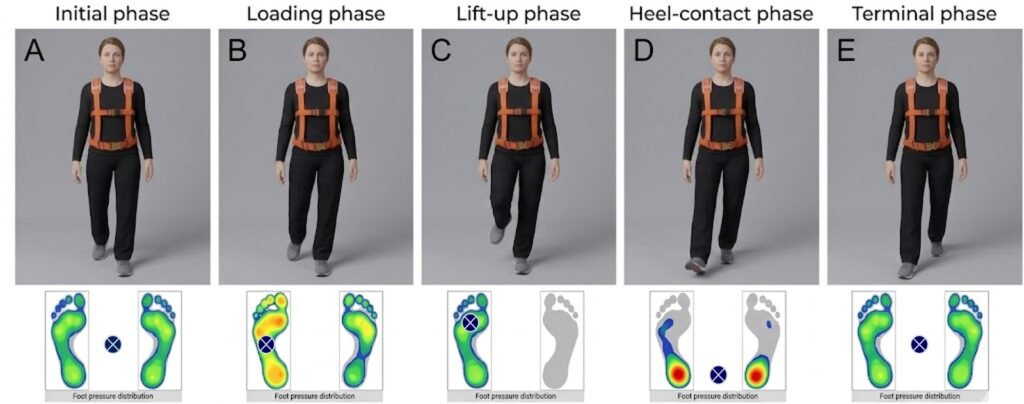
[Figure 1] Locomotor re-learning training. The walking task is divided into five component phases of the gait cycle: (A) Initial phase: Initial double stance position with body weight evenly distributed on both limbs. (B) Loading phase: Transfer and load of body weight onto the forward limb. (C) Lift-up phase: Knee flexion and lift of the posterior foot while maintaining upright posture and balance on the stance limb. (D) Heel-contact phase: Knee extension and heel strike on the floor. (E) Terminal phase: Terminal double stance position with body weight evenly distributed on both limbs.
The Training Process
The primary objective of this treatment approach is to restore gait stability by enhancing the patient’s conscious perception and control over dynamic balance and posture.
● Step 1: Weight Transfer Practice in Stance
Training begins safely in an upright standing position. Patients stand with their body weight evenly distributed on both legs (Initial phase). Once stable, they slowly and cautiously shift their body weight laterally until fully loaded onto one leg. They are instructed to stop, adjust their trunk and limb alignment, and stabilize before transferring weight in the opposite direction. If postural sway increases, they pause and resume only after regaining a stable posture. This facilitates conscious awareness of the body’s center.i
● Step 2: Segmented Gait Training
After static weight transfer practice, patients begin stepping movements:
• (B) Loading Phase: Patients slowly shift their body weight laterally and forward onto the anterior leg while maintaining an upright posture.
• (C) Lift-up Phase: After establishing proper alignment, they flex the posterior knee and carefully lift the heel, then the toe, off the floor while minimizing body sway.
• (D) Heel-contact Phase: The posterior foot swings forward, gently striking the floor with the heel first, maintaining balance on the stance limb.
• (E) Terminal Phase: Weight is transferred back to the center between the two legs to stabilize the body.
● Step 3: Utilizing Cognitive and Sensory Feedback
In every phase, attention is strictly directed to the conscious perception of body stability, alignment, and kinematics. Initially, patients practice using a four-wheeled forearm walker or with manual hand-hold support from a trainer. Frequent verbal instructions and physical guidance help the patient become aware of adequate movements. This assistance is gradually reduced as the patient becomes more independent.
● Step 4: Advanced Training (Forward Propulsion)
As postural stability is acquired, patients practice shifting their weight onto the forefoot area (ball or toe) instead of the center of the front foot during the loading phase by slightly inclining the trunk forward. This anterior shift utilizes additional propulsive force, facilitating forward progression and helping to reduce the common tendency of ataxia patients to fall backwards while walking.